AI engineer, Researcher & Founder.
My accepted paper at ICML 2026 is Likelihood over Estimation: Robust Quadratic Discriminant Analysis for Heavy-Tailed Distributions with Theory and Evidence. I'm building LawMate, an AI legal workspace for Kerala High Court advocates. PhD, Indian Institute of Science.
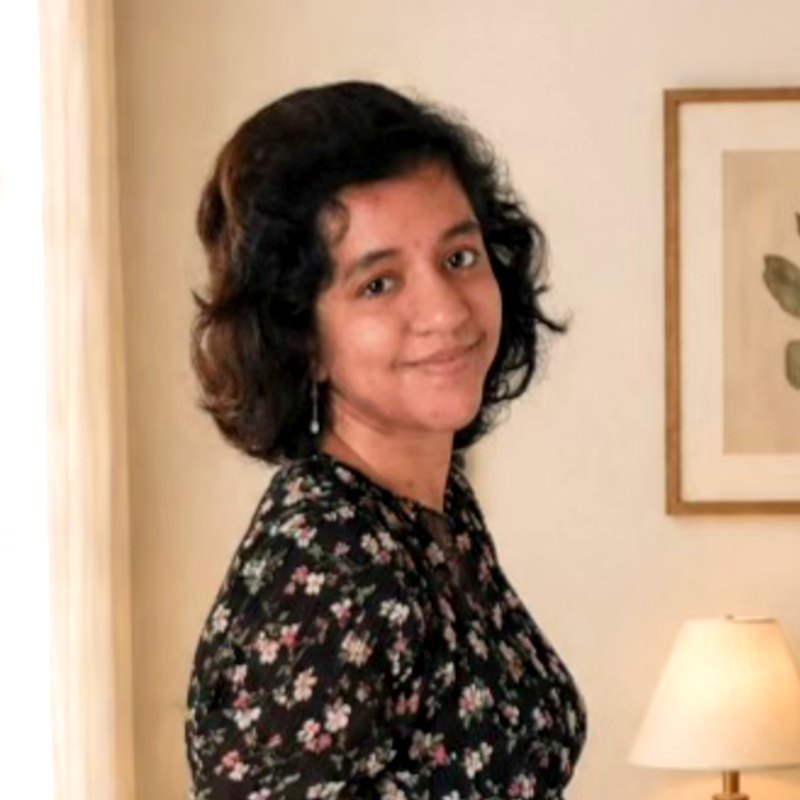
At ICML 2026 — Seoul
Likelihood over Estimation: Robust Quadratic Discriminant Analysis for Heavy-Tailed Distributions
Machine learning classifiers like Quadratic Discriminant Analysis (QDA) assume your data looks like a bell curve (Gaussian). But real-world data — fraud transactions, pulsar signals, network intrusions — has heavy tails: extreme outliers are far more common than a bell curve predicts. When you apply classical QDA to this kind of data, it fails to classify outliers correctly.
The core insight
There are two ways existing QDA can go wrong with heavy-tailed data:
- Wrong model — the Gaussian likelihood underweights outliers, so the classifier is systematically wrong even with perfect knowledge of the parameters.
- Wrong estimation — the standard covariance matrix estimator becomes unreliable (effectively blows up) when data has infinite variance.
The key finding is counterintuitive: fixing the likelihood model (problem #1) matters more than fixing the estimator (problem #2). Stable-QDA replaces the Gaussian likelihood with a multivariate elliptical α-stable distribution, which naturally handles heavy tails — and this drives most of the improvement.
What is an α-stable distribution?
Think of it as a generalization of the bell curve. Just as the Central Limit Theorem says averages of many random variables converge to a Gaussian, the Generalized CLT says that sums of heavy-tailed variables converge to an α-stable distribution. So α-stable is the "right" model for heavy-tailed phenomena by the same foundational logic that makes Gaussian the right model for ordinary data.
What did the paper prove?
Stable-QDA is Bayes consistent — given enough data, it converges to the theoretically best possible classifier. It works very well even if you don't know the exact tail heaviness (α = 1.5 works universally as a default). Classical QDA under heavy tails converges to the wrong answer permanently, no matter how much data you have.
Code & reproducibility
The full implementation of Stable-QDA and all experimental code are released on GitHub — the classifier itself plus scripts to reproduce every result in the paper, so researchers can build on this work or apply Stable-QDA directly to their own heavy-tailed classification problems.
Core Focus: Building Trustworthy AI Applications at Scale
What I'm working on
Research
Robust learning under heavy tails
My research work (ICML 2026) asks what happens to classical ML classifier QDA when the Gaussian assumption breaks — heavy tails, contamination, heteroscedasticity — and how correcting the likelihood makes classification effective again.
- Stable-QDA — likelihood correction beats estimator robustification (ICML 2026)
- Information-theoretic views of in-context learning & LLM inference
Founder · LawMate
An AI workspace for Kerala High Court advocates
LawMate brings court-safe AI to legal practice: drafting, judgment analysis, bilingual Malayalam–English translation, precedent research and more — with an architecture where citation hallucination is structurally impossible.
- Drafting tool with 29+ KHC document types, grounded generation with enforced citations
- BNS/BNSS/BSA ↔ IPC/CrPC/IEA statute crosswalk — deterministic tools
- Built on AWS Bedrock and AWS Agentcore with multi-tenant isolation by design
Background
Where I've been
2026 — PRESENT
Founder & CEO, LawMate Private Limited
Building an AI-powered legal workspace for Kerala High Court advocates — from architecture to go-to-market.
2022 — 2024
Associate, Goldman Sachs
Onboarding workflow for Private Wealth Management and Compliance automation at scale in a regulated environment.
2020
PhD, Indian Institute of Science, Bengaluru
Network information theory — matroid theory, network coding. Seven publications including ISIT, ICC, WCNC.
EARLIER
MS, Boston University · Applications Engineering, Oracle
Plus: MIT Schwarzman College of Computing Data Science & ML Certificate; DeepLearning.AI PyTorch Certificate.
Contact
Let's talk
- Meeting at ICML in Seoul?
- Exploring collaboration on robust ML, inference optimization, or linear algebra?
- Curious about AI for courts, looking for internships or wanting to contribute?
Kindly reach me at +1 (617) 487-9895 / lawmatekerala@gmail.com